
Staff Apps | Enterprises | Media | Support Services | Vision 2030 | Procurement | Tenders | Contact
Staff Apps | Enterprises | Media | Support Services | Vision 2030 | Procurement | Tenders | Contact
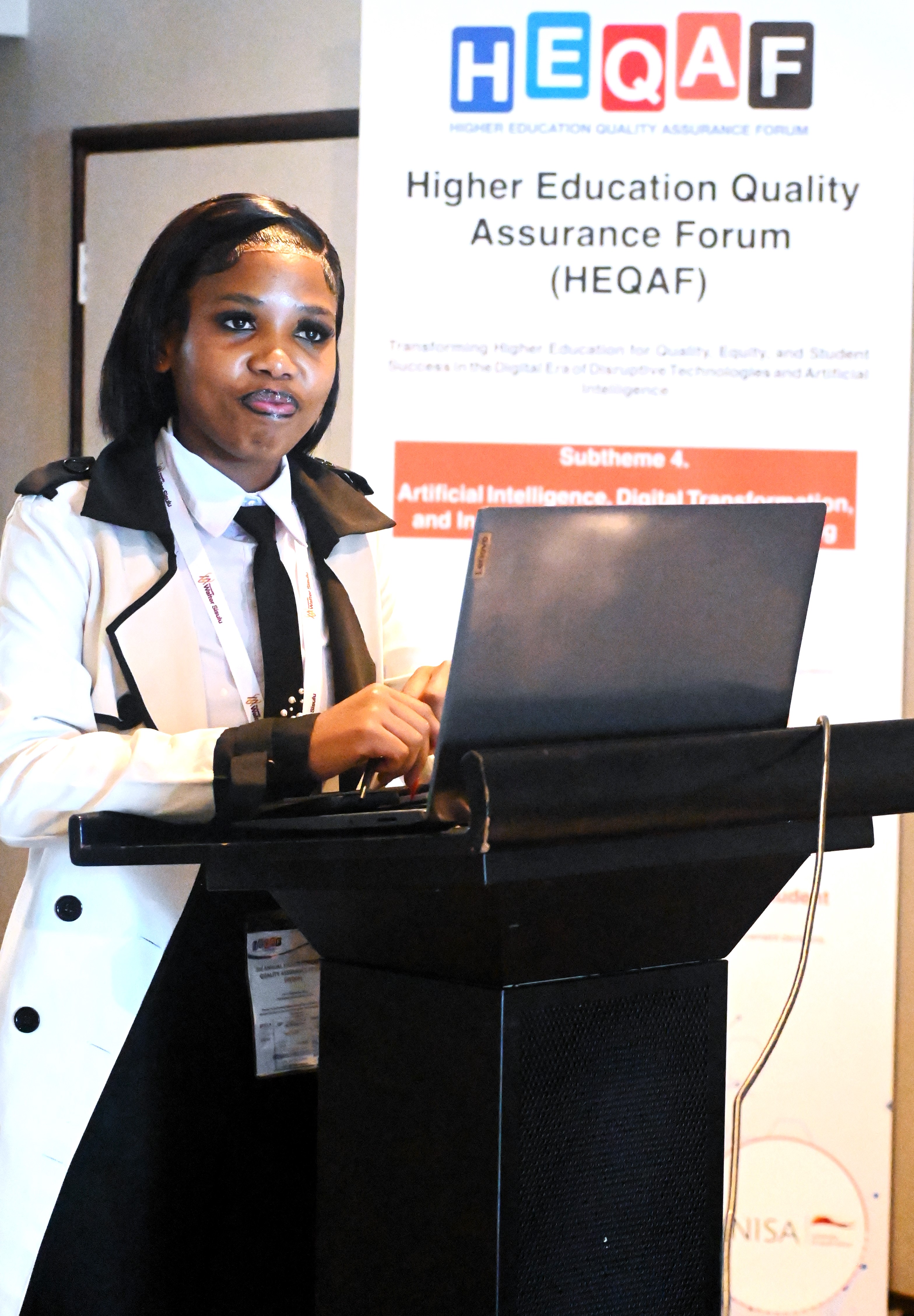 Nomfundo Smiso Muthwa who is currently serving as the Convener of the South African Women Lawyers Association Student Chapter at the University of South Africa (UNISA) and previously served as Deputy Secretary of the UNISA Law Students Association and Group Leader for the UNISA Law Clinic's Street Law Project, used her personal story to challenge how institutions define access.
In her introduction, she questioned how universities currently measure access. She noted that institutions commonly use indicators such as application rejections, admissions, enrolment management, attrition, graduation rates, and unemployment.
"I am not saying that these indicators are less imperative, they are important. What I am trying to say is that they do not tell the complete story,” she said.
"What may remain invisible is the fact that students who are rejected, we pay less attention to those students," she said.
Sharing her own experience, she revealed that she was rejected by higher education institutions for four consecutive years which is the duration of a full qualification before finding an alternative pathway through UNISA.
"I was rejected by higher institutions for four consecutive years, which is a full qualification. But here I am today presenting at the conference," she said.
She argued that current quality assurance frameworks make other realities invisible, including socioeconomic barriers, non-linear educational pathways, technological barriers, students' sense of belonging, and the support needed to succeed.
Muthwasaid rejection often feels like the end of the world for many young people, creating disappointment, self-doubt and uncertainty among family and friends.
Muthwa’s research calls for institutions to do more after sending a rejection letter which includes providing clear reasons for rejection, offering reassurance and psychological support, providing career guidance and alternative pathways, expanding bridging, foundation and Open Distance Learning opportunities
Reflecting on her own transformation, she said, “My journey suggests that access is not always linear. My journey suggests that rejection does not necessarily indicate lack of potential.”
“Alternative pathways can create new opportunities. Flexible education can support non-traditional students, and I am the living proof of that.”
She emphasised that her experience became more than a personal story when she started using it to support other students, using social media platforms to share messages of resilience with young people facing similar barriers.
In her conclusion, Muthwa challenged quality assurance bodies to move from just finding problems to providing solutions. Her findings propose that institutions should make rejection transparent, humanise rejection, track the rejected student journey and use student voices as quality assurance evidence.
"QA now automatically shifts from 'why was the student rejected?' to 'what can the institution do after rejection to keep the pathway to education open'," she concluded.
By: Asenathi Danayi