 Languages:
 My WSU | Student Life | Enterprises | Media | Support Services | Vision 2030 | Procurement | Tenders | Contact

WSU HOSTS TRANSFORMATIVE SheSTEAM SUMMIT EMPOWERING YOUNG GIRLS IN SCIENCE AND INNOVATION
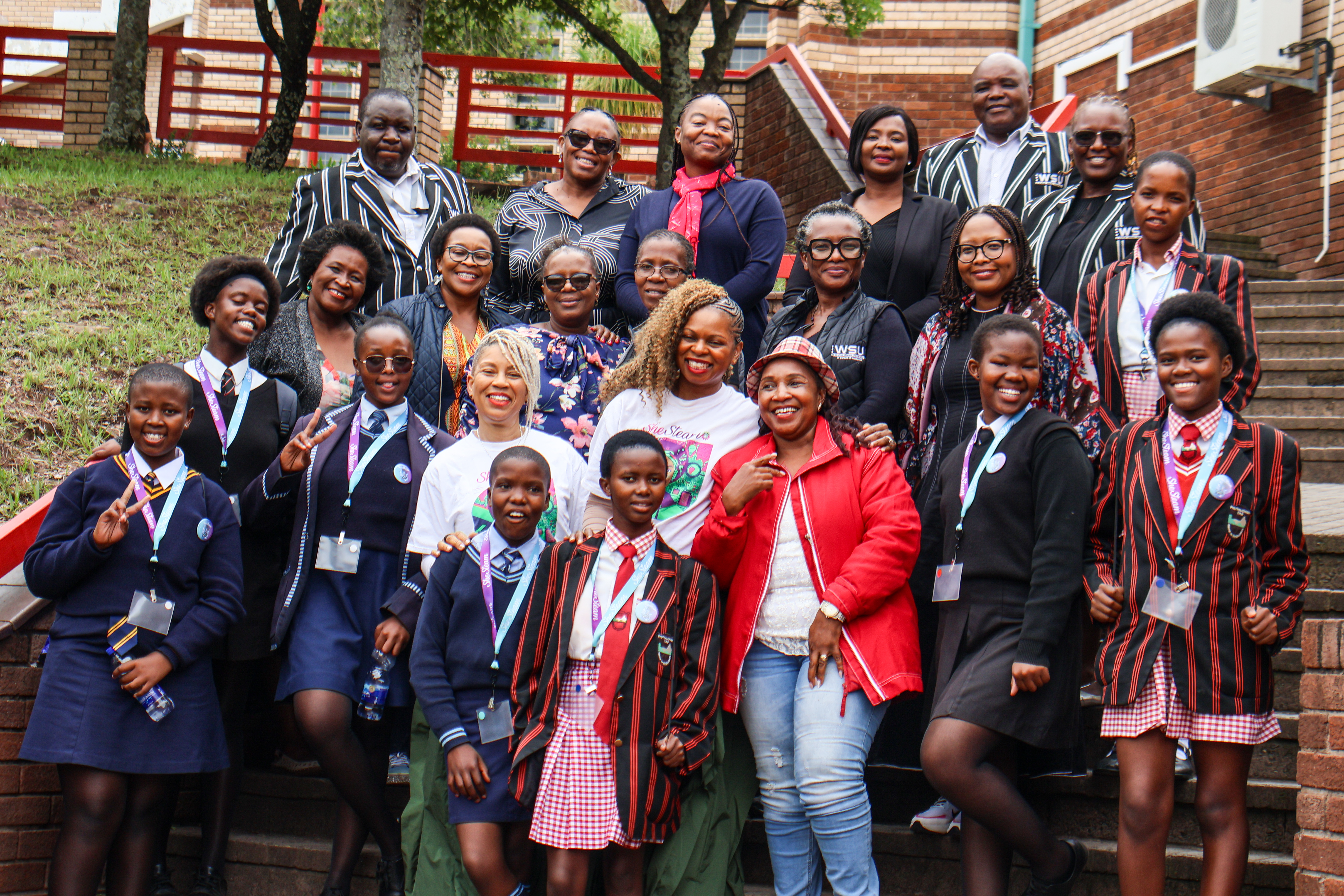
At least 300 Grade 8-12 learners converged at the Walter Sisulu University (WSU) Whittlesea Campus on Saturday as the Faculty of Education hosted a dynamic, science-centred summit in collaboration with the South African Council for Natural Scientific Professions (SACNASP) and the African Research Collaborative (ARC).
The SheSTEAM Summit brought together female learners from the Chris Hani and Alfred Nzo District Municipalities for an immersive experience designed to ignite curiosity, build confidence, and expand access to opportunities in science, technology, engineering, arts, and mathematics (STEAM).
Throughout the programme, learners participated in engaging activities including hackathons where they designed solution-driven websites through Artificial Intelligence (AI), coding and robotics sessions where they studied the construction of drones and robots, coding and plugged and unplugged approached to coding and robotics.
Officially opening the summit, the Executive Dean of the Faculty of Education, Prof Bongani Bantwini, delivered a compelling address, urging educators, parents, industry partners, and communities to work collectively in unlocking the full potential of girls and young women in STEM fields.
“The world is changing faster than ever before. We are living in a time of artificial intelligence, climate change, and rapidly evolving healthcare; all of which demand scientific innovation, research, and creative problem-solving,” said Prof Bantwini.
He spoke on the significance of diversity in innovation, adding: “The future will not wait, and it requires diverse thinkers. When women are included in scientific and technological design, solutions become safer, more inclusive, and more effective. When girls are empowered to pursue mathematics and engineering, societies grow stronger.”
Meanwhile, the representative of the South African Council for Natural Scientific Professions, Dr Matshidiso Matabane, placed young people in STEM at the heart of societal transformation, reaffirming science, technology, and innovation as key drivers of social and economic development.
“We are placing Science, Technology and Innovation at the centre of government, education, industry, and society, so that science helps improve our lives, strengthen education, grow the economy, and solve societal problems,” she said.
Encouraging learners to take ownership of their futures, Matabane added: “Today is all about you. It is about your future, your dreams, and your potential. The future scientists, engineers, and innovators of the Eastern Cape and across Africa are in this room. Success comes with hard work, curiosity, responsibility, and discipline.”
The co-founders of the African Research Collaborative, Dr Melissa Speight Vaughn and Dr Erica Bass-Flimmons, shared their passion for advancing inclusive education and empowering learners in rural communities through STEAM initiatives.
“We focus on rural areas because urban areas already have access to resources. We want to level the playing field and bring opportunities to communities that are often overlooked,” said Dr Vaughn.
Dr Bass-Flimmons reflected on the origins of the programme, noting: “When I first visited Soweto as a student, a learner asked me how they could be productive using technology. That question sparked a journey that eventually led us to create SheSTEAM, to provide young people with the tools, training, and encouragement they need to shape their futures.”
Indeed, this sentiment was powerfully reflected in the learners’ energetic engagement throughout the program activities.
One learner, Sineqhaya Jordan from Mazipho Senior Secondary School, said, “I’ve learned that every girl needs to be very confident and bold in pursuing their dreams. We need to venture into more careers that will improve the country’s economy.”
On behalf of the Eastern Cape Department of Education, Deputy Director-General Chulekazi Xundu-Bula expressed heartfelt appreciation to all partners involved. “Your support is helping us give these learners a better future, and we celebrate the creativity, intelligence, and immense potential of the young women participating today,” she said.
In closing, Prof Bantwini highlighted that the initiative is not about exclusion, but about correcting historical imbalances and ensuring that young women are meaningfully equipped to shape future scientific and technological spaces.
-By Ongezwa Sigodi
Contact Us
Email Address:
Contact Numbers:
Mthatha: 047 502 2100
Butterworth: 047 401 6000
East London: 043 702 9200
Potsdam: 043 708 5200
Chiselhurst: 043 709 4000
Follow us on Social Media
 |
 |
 |
 |
 |
 |
