 Languages:
 My WSU | Student Life | Enterprises | Media | Support Services | Vision 2030 | Procurement | Tenders | Contact

MEC SIBULELE NGONGO FULL SPEECH: ARCHBISHOP THABO MAKHOBA ANNUAL LECTURE
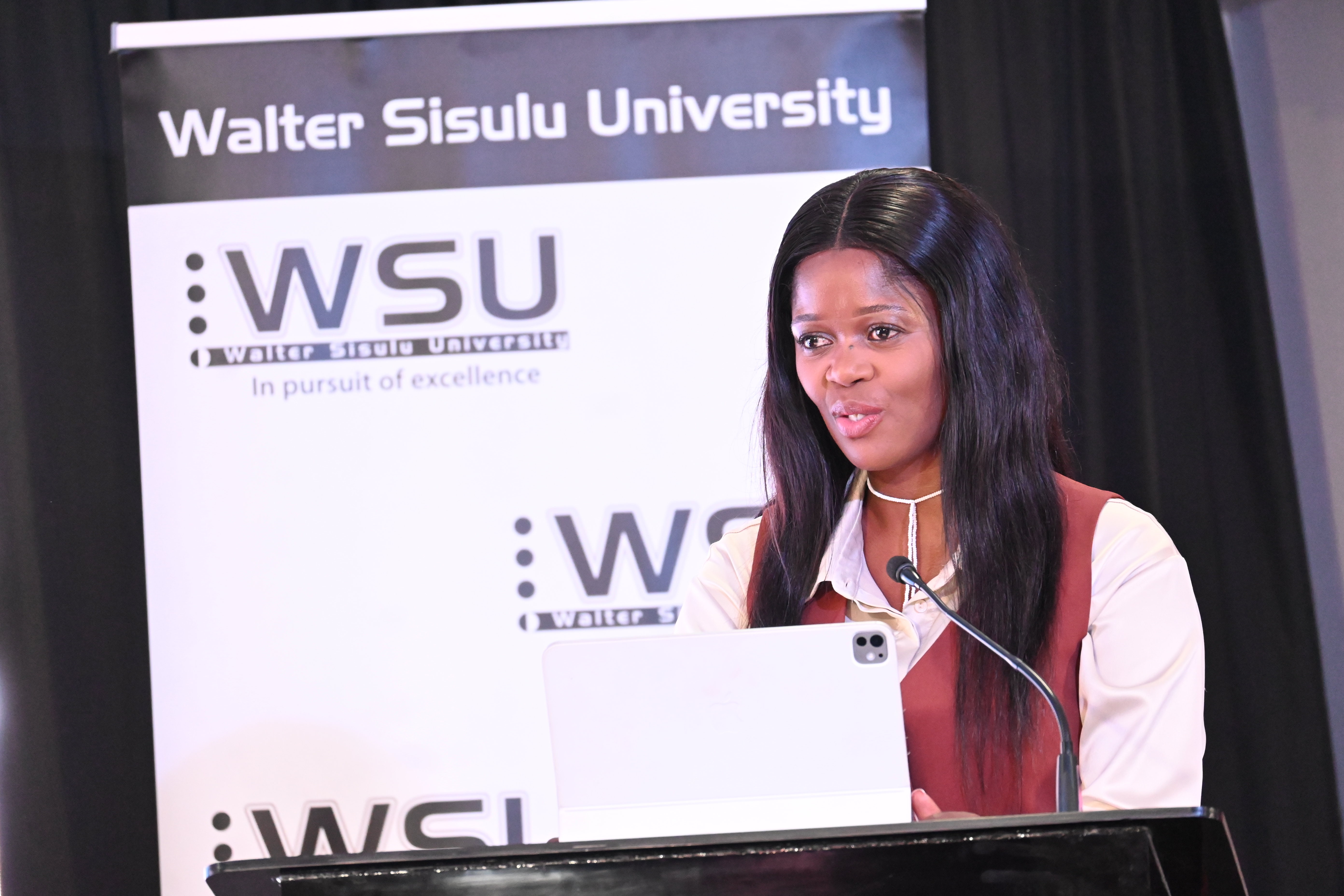
Programme Director
Members of the Council present
Vice Chancellor of WSU Dr Thandi Mgwebi and DVCs
A special greeting to the Bishop himself and your Wife (who are joining us virtually)
Greetings to the Leadership of the Archbishop Thabo Makgoba Development Trust (ATMDT)
Student Leadership from the University
Ladies and Gentlemen who are joining us virtually and in social media platforms.
- As we gather today, allow me to express my deep appreciation for the opportunity to hopefully make a meaningful contribution in this exchange of ideas in pursuit of nation building. Imnandi ke nale yokuba ndibizwe apha kwaXhamela kuba ndixhonxwe kwakweliziko.
- Programme Director, Allow me to begin by warmly congratulating and acknowledging the newly appointed Vice-Chancellor of Walter Sisulu University, Dr Thandi Mgwebi.
- Vice-Chancellor, while this may be the first time we are meeting in our official capacities, we did have the pleasure of crossing paths during the December festivities. It is therefore a privilege to now engage in a formal setting, as we collectively advance the work of this great institution.
- Your appointment marks not only a personal milestone, but an important moment for Walter Sisulu University and for higher education in our province. We wish you strength, wisdom and bold leadership in steering the university forward in pursuit of excellence.
- I also wish to commend the Council of Walter Sisulu University for its deliberate and progressive leadership. The appointment of women Vice-Chancellors for two consecutive terms is not by chance it reflects intentional transformation and confidence in women’s leadership at the highest level. Indeed, this is transformation in action. Intle, iyancomeka kwaye iyabukeka.
- An opportunity briefly to reflect on the contribution and leadership role of women in a society that has still not fully accepted them for who they truly and what they are capable of. Put differently, the role of women in a society that is deeply entangled by patriarchy. This to be done under the theme “Women and resilience: Perspectives from leadership”.
- My understanding of the theme is that we are to interrogate the emancipation of women in today’s world. Not only just women, also young women in a changing world where they have the burden of leadership.
- Whilst acknowledging that world is structured along patriarchal lines, I must also state that not all patriarchal societies are the same and the oppression of women in various formations differs based on the economic and political differences of those societies. For example, patriarchy will manifest differently in advanced capitalist societies to traditional rural societies where economies are structured differently. Patriarchy has not always existed and can also be dismantled.
- I must say that it is not entirely possible to reflect on todays struggles or challenges faced by women without looking back at South Africa’s history. Maybe, even a brief look into our understanding of gendered roles that the entire world would have attempted to prescribe for women. In the defiance of these prescribed roles, I do think that the resilience part of our theme will also reflect.
- It is common knowledge that South Africa has a history of colonialism. Colonialism we defined as a Special Type because we occupied the same land as our colonisers. Deeply imbedded in this was the oppression and exploitation of Blacks in general and Africans in particular. A strong feature of this history is the use of violence as an enforcer or enabler by the oppressors.
Violence an enforcer in two ways – firstly by the system and secondly by men. Women who refuse to ‘obey men’ are often subjected to violence by men. In this instance, men also use violence as means for punishment.
- It is also generally accepted that women in South Africa were triply oppressed. Oppressed in terms of race, gender and class. This meant that they are severely marginalized, subjecting them to poverty, little or no political activism, violence etc.
- We have accepted that race meant the use of colour or pigmentation to intentionally and systematically exclude a group of people. I stress systematically because, of late, we have seen attempts to distort what we mean by racism.
- Gender is a creation by societies to order the roles of men and women, and it is bound up with political and economic objectives. Siyayazi uba oMama bebesaya kujongelwa ukupheka nokuzala kuphela. Nasesikolweni, xa efika kuStd 3-6, bekuthiwa sefunde kakhulu futhi uvutshiwe ngoku angayokwenda.
- Gender is constructed socially and identifies the relationship between men and women in the context of power relations. Gender is not natural or God-given but is created by society through socialisation using institutions such as the family, the church and religion, school and education and the state and laws. Gender relations can therefore be changed by the very same society that created them.
- Gender roles exist in all spheres of society starting with the division of labour in the family. Women are allocated the role of being child bearers and are given the duties of cleaning and cooking. In fact, women are allocated the tasks of domestic chores as if it were natural for them to have to do this. This work is hidden and not paid for. It is not registered as work within the tools that we use to analyse the working of the economy such as in Gross Domestic Product (GDP) figures.
- From these gender roles, certain characteristics are expected of men that are a reflection of what it means to be male or to be masculine while other characteristics are attributed to women as a reflection of their femininity. The notions of masculinity and femininity define how men and women must behave and how they must look. They refer to physical appearance, psychological states, sexual orientations, intellectual capability and emotional states. For example, men are supposed to be natural leaders, decision makers and providers in society beginning within the family while women are the caregivers, supporters and followers of men.
- As I step off on the gendered roles, I must part by saying that it is not only women that must be freed from these roles. Men must also be freed from the chains of patriarchy and be made to appreciate a better world where men and women live side by side as equals.
- Since the ushering in of the democratic dispensation, much work has been done to recognise the capabilities of women. We have seen an increasing number of women occupying leadership positions in strategic institutions. We now have the first woman to be appointed as Chief Justice; we have had the First woman to be Deputy President of the country. WSU has a had more than one VC as women and its SRCs. However, our maturing democracy is yet to have a women president.
To what extent can we use this as an indicator? Whilst women are constitutionally allowed to be elected, how ready is our South African society for a women president?
- In spite of this progress, I fear that the moral fibre of our value system of our society is being eroded. This coupled with a society that still carries a value system entrenched on looking down on women. A society that has different standards for male and females. When we as women make errors, the judgement is much harsher, and it is associated with our bodies. Eyy abafazi kanene banjalo. Yet, when it is males, the faults are generally accepted as genuine shortfalls and are hardly linked nesitho sakhe umntu.
Nanamhlanje, we (both men and women) still better explain impazamo zamadoda. Xa ingoMama, we hold them to a higher standard. Yes, we should never drop the standards we hold each other accountable.
- This in avertedly places a much bigger responsibility on those women who have been given the responsibility to lead. Whilst we must acknowledge the sacrifices and gains made by the giants (Albertina Sisulu, Adelaide Tambo, Sophia Williams-De Bruyn) whose shoulders we stand on, we must also be fully conscious that our conduct has the potential to unlock many barriers. Every sacrifice, every step gained and every bit of success by women in leadership should be to ensure the emancipation of future generations.
- As we pursue this better world, we must know that there is no society or group of people that has developed without placing education and innovation at the centre of its trajectory. This is particularly important for leadership. We must, always seek to better ourselves. This will ensure that we apply scientific measures to address our socio-economic challenges.
Education will also ensure that we are better equipped to accept any criticism that we receive. It will also enable us to better understand developmental trends.
- It is only an educated society with innovative methods that will be able to fight GBV&F. it is only through improved consciousness that men will stop seeing women bodies as their crime scene. Only a conscious society fully appreciates the destructive nature of GBV+F on our families and communities.
- As we educate our young girls and women in general, we must also challenge ourselves to improve our appreciation of the TVET sector. This is important in a country that is battling unemployment. Recent figures indicate that the youth is the most affected sector of our community. The skills gained at these institutions enable our people to be employment creators than job seekers.
- In closing, young women from working class background have it the hardest. They have far more hurdles to cross in pursuit of a better world. However, you have the skills and talent to make it. Omama Mandisa Maya, Phumzile Mlambo-Ngcuka yimizekelo esaphilayo ukuba with enough dedication and commitment, we surely can make it.
Thank you
Contact Us
Email Address:
Contact Numbers:
Mthatha: 047 502 2100
Butterworth: 047 401 6000
East London: 043 702 9200
Potsdam: 043 708 5200
Chiselhurst: 043 709 4000
Follow us on Social Media
 |
 |
 |
 |
 |
 |
