 Languages:
 My WSU | Student Life | Enterprises | Media | Support Services | Vision 2030 | Procurement | Tenders | Contact

WSU–SAMSUNG INNOVATION CAMPUS GRADUATES 50 IT STUDENTS IN CODIING, PROGRAMMING & ARTIFICIAL INTELLIGENCE
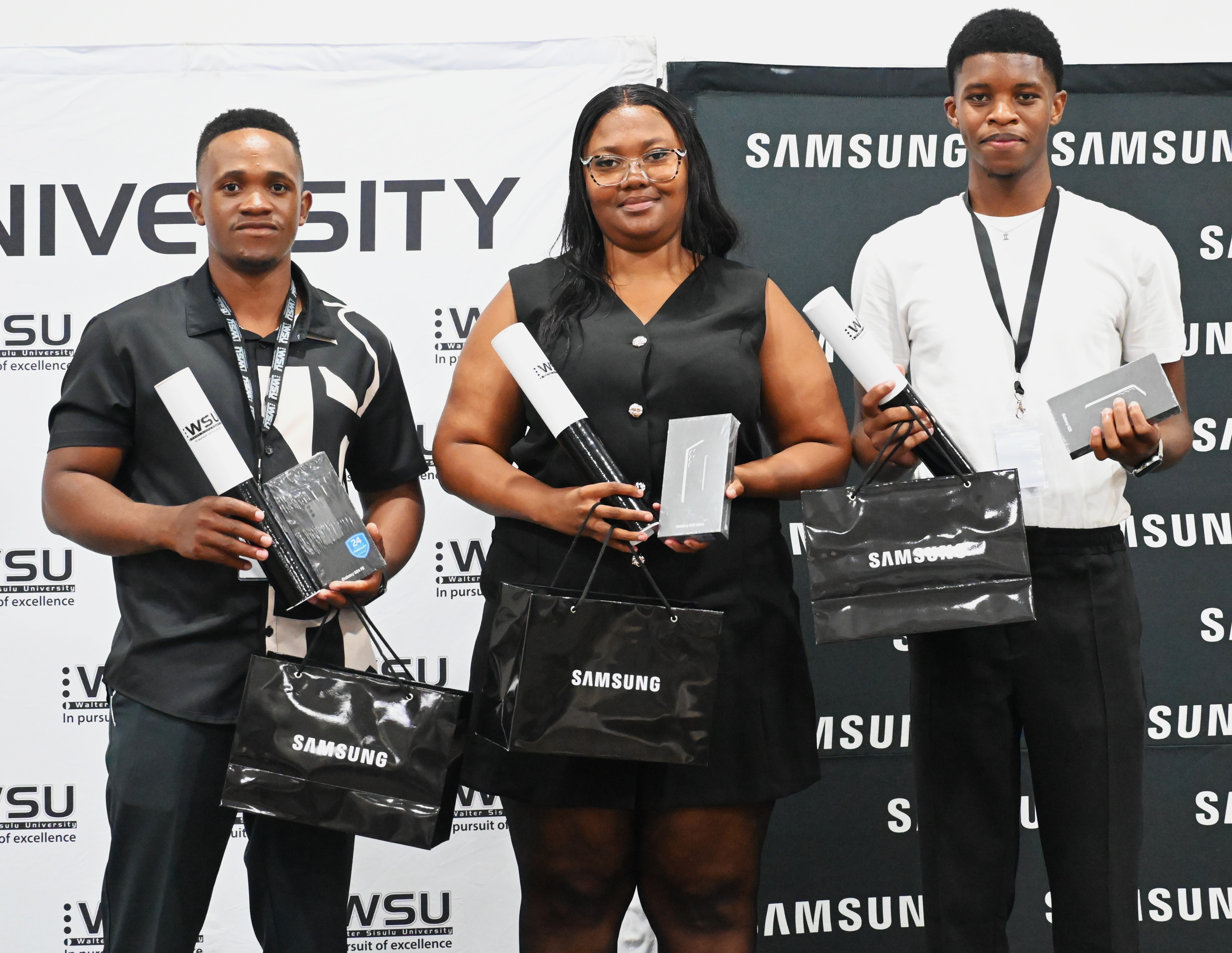
Thanks to a digital skills programme initiated by Walter Sisulu University and cellular giants Samsung, yet another group of WSU students is now armed with scarce skills for the ever rapidly-growing technology-driven job market ready to adapt to changes brought by the Fourth Industrial Revolution.
A celebratory air swept through the Osner Hotel in East London on Monday, 23 February, as the Information Technology students crossed the stage as the fourth cohort of the WSU–Samsung Innovation Campus skills development programme.
Parents beamed, cameras flashed, and applause echoed across the venue as the largest group since the programme’s inception in 2022 received certification in Coding, Programming, and Artificial Intelligence.
What began four years ago as a modest intervention has steadily evolved into a flagship digital skills initiative, equipping students for the demands of the Fourth Industrial Revolution.
Launched through a strategic partnership between WSU and Samsung Electronics, the Innovation Campus was designed to bridge the widening gap between traditional academic training and the rapidly shifting demands of the technology-driven job market.
With the graduation of the 2026 cohort, 119 WSU IT students will have successfully completed the programme since its launch - a trajectory of growth from 19 students in 2022 to 25 in 2023 and 2024, and now 50.
At its core, the intervention is both rigorous and forward-looking, and, according to Centre for Entrepreneurship Rapid Incubator (WSU-CfERI) Business Development Officer Sabelo Malindisa, the 2025 Coding and Programming stream unfolded as a demanding 143-hour intensive course from 1 August to 10 December 2025.
“The curriculum focuses on Python and includes programming fundamentals; conditional logic and loops; functions and recursion; object-oriented programming; data structures; sorting and searching algorithms; problem-solving methodologies; data processing and visualisation; mini-projects and a final capstone project,” Malindisa explained.
The capstone presentations, he noted, required students to demonstrate not only technical competence but the ability to translate theory into practical, real-world solutions, a significant past of the programme’s job-readiness focus.
Addressing an audience filled with graduates, mentors, government representatives, academics, and proud families, WSU Vice-Chancellor Dr Thandi Mgwebi situated the ceremony and initiative within a broader national imperative.
“Digital skills development isn’t just a WSU priority, but a government priority,” she asserted. “When government, industry, and university align, we create cohesion and alignment for the purpose of a common goal.”
Mgwebi emphasised that the Innovation Campus represents more than a technical training pipeline; it is an investment in the country’s developmental future.
“We are developing essential competencies in coding and structured problem-solving, foundational skills for economic development that apply across disciplines such as finance, governance, agriculture, health systems, and manufacturing,” she said.
In a pointed reminder that innovation knows no disciplinary boundaries, she challenged graduates to think expansively about their societal role.
“You may not be studying health systems, but your skills are needed in the health system,” Mgwebi noted adding that data science and programming must become tools that improve rural productivity. Think hard about how you can apply these skills in real life.”
Corporate Social Responsibility Manager for Samsung Electronics Southern Africa, Lefa Makgato, echoed this sentiment, acknowledging both the resilience of the graduates and the harsh socioeconomic realities many face.
She explained that such challenges were precisely what compelled Samsung to invest in meaningful, future-oriented interventions.
“Together with our partners, WSU and the Eastern Cape government, we have since inception been seeking to bridge the gap between traditional education and the demand for skills training tailored specifically for the current job market that requires modern tech expertise,” Makgato said.
“For us at Samsung, this partnership exemplifies the kind of public, private partnership that has ensured that together, we can continue training the leaders of tomorrow to use AI tools and other innovative technology platforms to effectively maximise the benefits of these new and exciting emerging technologies in their future careers,” Makgatho further added.
For these 50 students, the Innovation Campus was not merely an extracurricular programme, but an entry point into a digital future, one coded not only in Python, but in possibility.
By Thando Cezula
Contact Us
Email Address:
Contact Numbers:
Mthatha: 047 502 2100
Butterworth: 047 401 6000
East London: 043 702 9200
Potsdam: 043 708 5200
Chiselhurst: 043 709 4000
Follow us on Social Media
 |
 |
 |
 |
 |
 |
