
Languages:
Staff Apps | Enterprises | Media | Support Services | Vision 2030 | Procurement | Tenders | Contact
Staff Apps | Enterprises | Media | Support Services | Vision 2030 | Procurement | Tenders | Contact
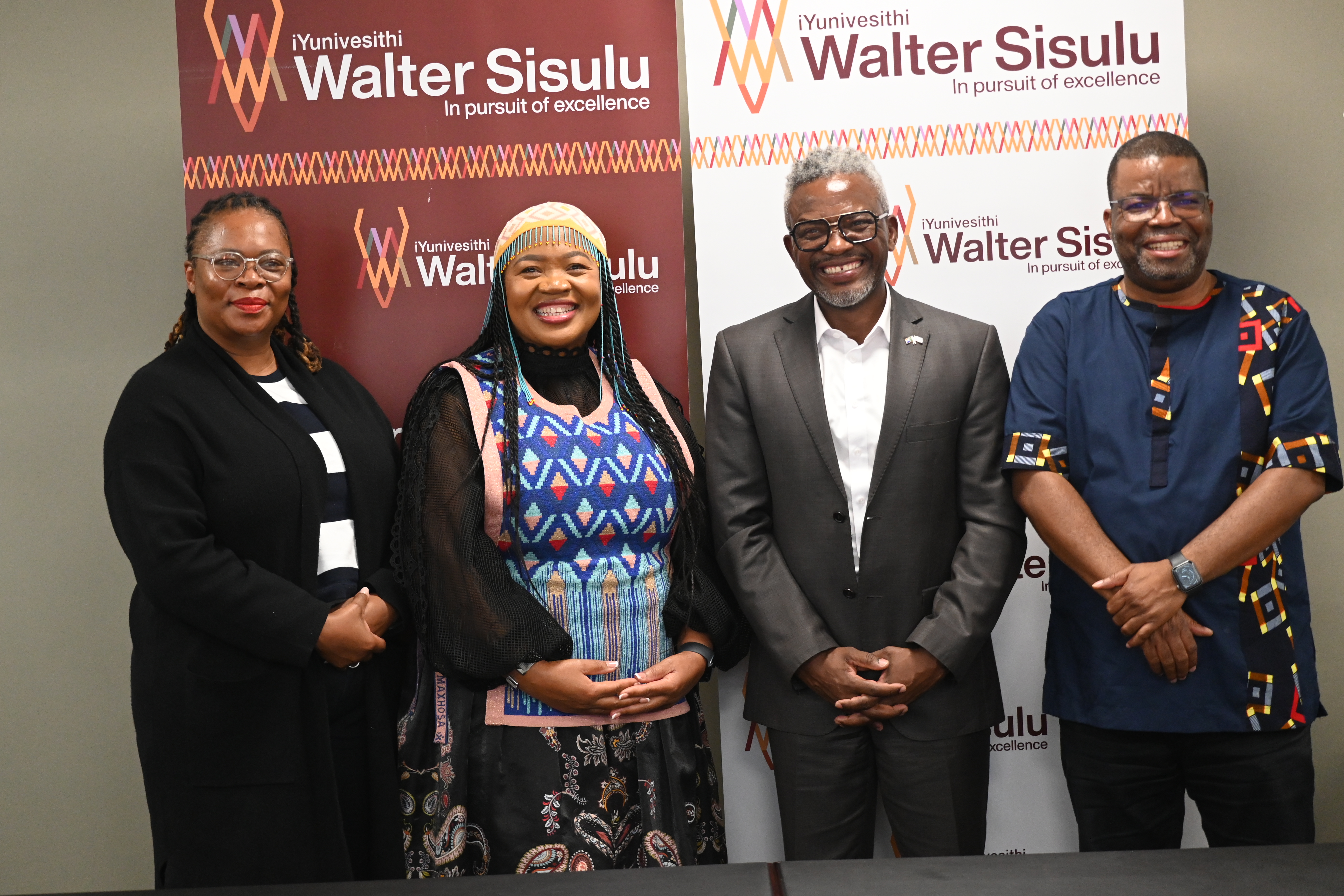
A strategic partnership between iYunivesithi Walter Sisulu and the South African National Space Agency (SANSA) is expected to unlock new opportunities in space science, rural development innovation and community-centred development following the signing of a five-year Memorandum of Understanding (MoU) at the university’s Butterworth Campus on Tuesday.
The agreement, signed by Vice-Chancellor and Principal Dr Thandi Mgwebi alongside SANSA Chief Executive Officer Dr Humbulani Mudau, establishes a framework for collaboration in areas including geospatial information sciences, Earth observation, postgraduate development, student bursaries, internships, joint research publications and community engagement initiatives.
Speaking during the engagement, Dr Mgwebi stressed that the partnership must move beyond ceremonial agreements and produce visible impact within communities.
“We’re hoping that immediately after this, the implementation plan will come. We want to be a model of a university partnership with SANSA and be committed to making it work,” she said.
The MoU positions SANSA to provide leadership in skills programmes linked to the National Development Plan, Earth intelligence, data science and the National Resources Management Programme, while the university will focus on postgraduate support, community engagement, science diplomacy and advancing knowledge production in space and geographical sciences.
Discussions during the signing centred on how science and technology could respond directly to challenges affecting rural communities, particularly in agriculture, biodiversity, clean energy, mining and spatial planning.
Dr Mudau said the partnership aligned with SANSA’s recently launched National Resources Management Programme (NRPM), which seeks to use science and satellite-based technologies to unlock opportunities within communities.
“The thinking behind that is us beginning to understand not just the challenges that exist in communities, but what opportunities can we unlock, be it agriculture, biodiversity, mining and also clean energy,” he said.
Reflecting on the realities facing many rural communities, Madau described travelling through parts of the Eastern Cape still affected by a lack of electricity despite the province’s natural wind resources.
However, the collaboration would further include joint short-learning programmes, workshops, conferences, postgraduate co-supervision and curriculum development aimed at strengthening applied research and innovation.
Dr Madau revealed that SANSA was ready to collaborate with the university in establishing programmes in remote sensing and geospatial sciences while incorporating entrepreneurship and innovation into scientific training.
“We need to start thinking about bringing in the business development aspects and entrepreneurship into our programmes so that they don’t go looking for jobs only, but start creating opportunities here,” he said.
iYunivesithi Walter Sisulu Deputy Executive Dean of the Faculty of Natural Sciences, Dr Palesa Sekhejane, said the university would serve as a partner to the Eastern Cape, taking a hub-and-spoke model for SANSA’s National Resources Management Programme.
She explained that the partnership would support applied research projects combining satellite intelligence with indigenous knowledge systems in climate-resilient agriculture, sustainable marine economy initiatives and the water-food-health nexus.
“The partnership is also expected to strengthen spatial planning, resource management and international collaboration in space science and applied research, while empowering students and local communities through science-driven innovation,” she said.
By: Yolanda Palezweni