

About Walter Sisulu
Get in touch
Email Address:
Contact Numbers:
Mthatha: 047 502 2100
Butterworth: 047 401 6000
East London: 043 702 9200
Potsdam: 043 708 5200
Chiselhurst: 043 709 4000
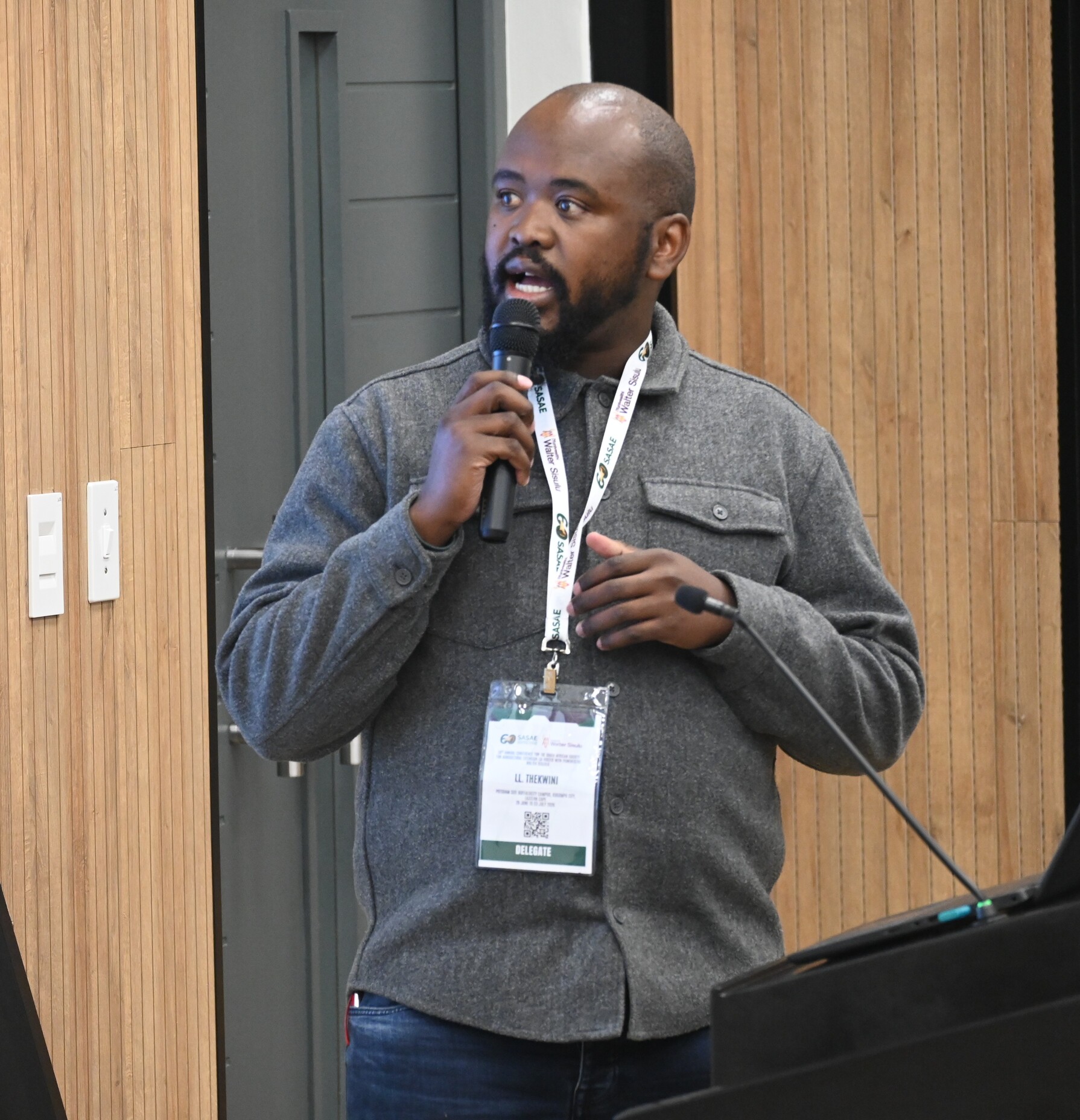 Rabbit farming could offer a practical solution to food insecurity, climate change and rural poverty while creating new economic opportunities for women and smallholder farmers in the Eastern Cape.
These assertions were made by agricultural advisor Luvo Thekwini of the Eastern Cape Department of Agriculture during the South African Society for Agricultural Extension (SASAE) Conference held at Walter Sisulu’s Potsdam Campus.
Presenting a paper titled Rabbit Production as a Climate-Smart Small Livestock Enterprise: Extension-led Insights from a Rural Cooperative in the Eastern Cape, Thekwini explored how rabbit farming could strengthen sustainable agriculture in water scarce rural communities.
The study focused on a cooperative where rabbit farming has demonstrated potential to improve food security, generate income and build resilient livelihoods. According to Thekwini, the enterprise required relatively little land, water and financial investment, making it an attractive option for smallholder farmers.
"As we know that climate is changing over time, we need climate-smart practices such as rabbit production through intensive farming. Rabbit farming is a low input practice that doesn't require high capital to start. Smallholder farmers can start on a lower level and increase as time goes on," he said.
Beyond meat production, the research found that rabbit farming could diversify rural incomes through breeding stock sales, organic fertiliser production and integrated vegetable farming.
Rabbit manure, he said, could be used as an organic fertiliser, reducing reliance on chemical inputs while supporting crop production.
Thekwini also highlighted the important role played by agricultural extension practitioners in helping farmers adopt climate-smart farming methods.
His study assessed how extension and advisory services supported the establishment and sustainability of the cooperative, demonstrating the value of ongoing technical guidance in improving production and connecting research with farming communities.
Thekwini further noted that rabbit farming presented opportunities for women's economic empowerment because it is less labour intensive and easier to manage than many conventional livestock enterprises.
"The social benefits of rabbit farming include reducing food insecurity and generating income. There's also a possibility for women empowerment since it doesn't require too much energy to manage," he said.
While the study identified challenges including limited infrastructure and water scarcity, Thekwini recommended greater extension support, improved access to veterinary services and stronger market linkages to unlock the full potential of rabbit farming.
He concluded that investing in climate-smart livestock enterprises such as rabbit farming could strengthen rural livelihoods while helping the agricultural sector adapt to a changing climate.
By Yanga Ziwele
Walter Sisulu University
Every gift moves us forward.

The Walter Sisulu Legacy Fund is an opportunity for alumni, staff, partners and friends of the University to invest in the long-term future of Walter Sisulu.
It exists to expand opportunity for students, support academic excellence and innovation, respond to strategic priorities, and build a more resilient institution.
Why give? Because the strength of a university is built across generations. Your contribution helps Walter Sisulu to:
Join the movement. Watch the Fund grow. Add your name to the legacy.