
Languages:
Staff Apps | Enterprises | Media | Support Services | Vision 2030 | Procurement | Tenders | Contact
Staff Apps | Enterprises | Media | Support Services | Vision 2030 | Procurement | Tenders | Contact
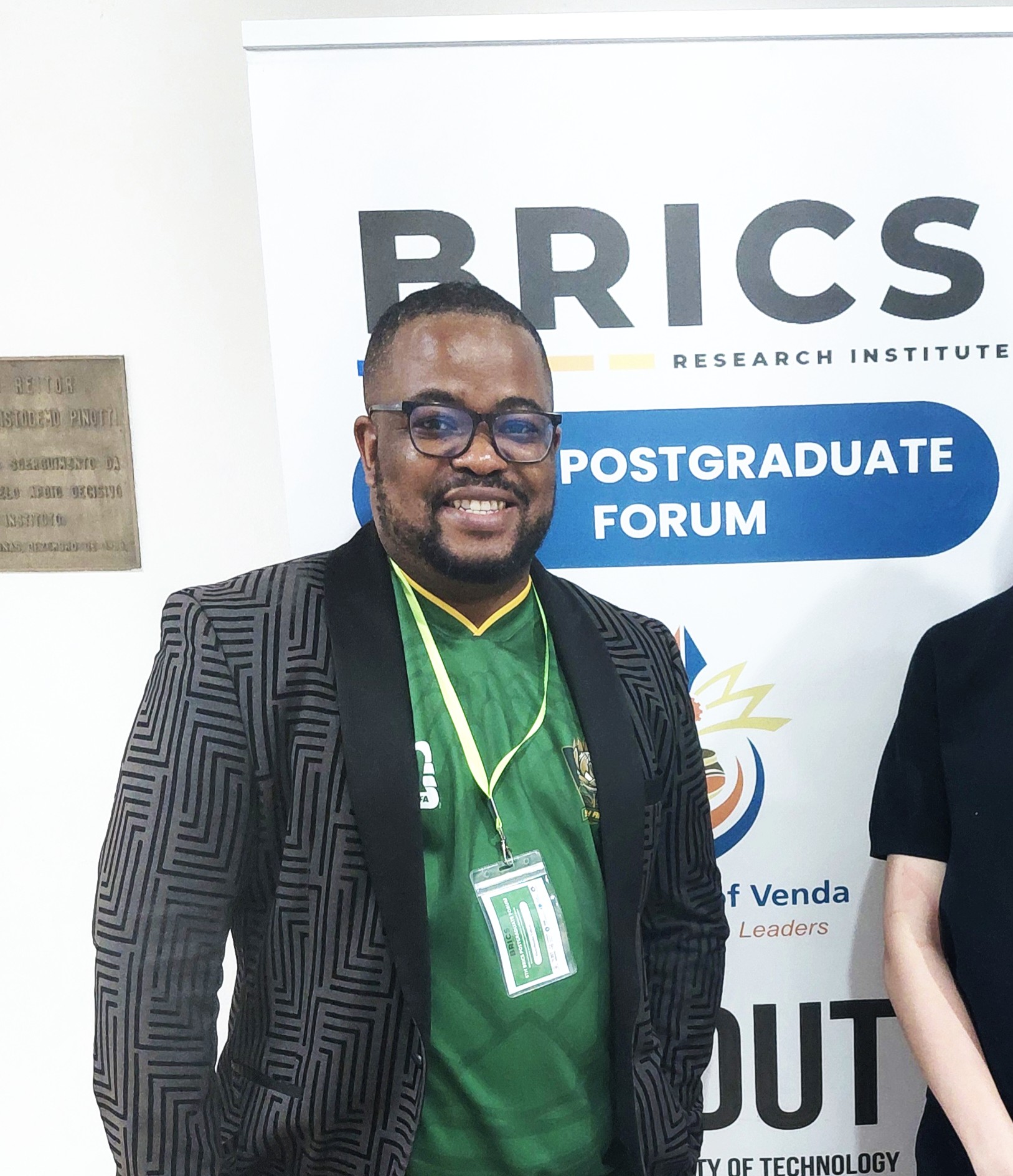 iYunivesithi Walter Sisulu lecturer, Bhekithemba Vellem was recognised as one of three top emerging scholars who presented at the 5th BRICS Postgraduate Forum for his groundbreaking mobile health application research designed to empower students manage stress more effectively.
A PhD candidate and nursing lecturer in the Faculty of Medicine and Health Sciences, Vellem’s paper titled: “Co-designing a Context-Driven Mobile Health Innovation for Stress Management among Health Sciences Students in Resource-Limited Settings,” forms a vital part of his ongoing doctoral research project.
“The study employed a convergent parallel mixed-methods design, with a user-centred approach integrated throughout the developmental stage of the intervention. I presented key findings that highlighted major stressors faced by students, including academic workload, financial challenges, clinical placement demands, and the strain caused by student unrest and institutional disruptions,” Vellem explained.
He added that his presentation outlined significant gaps in existing institutional mental health support services, as well as the need for scalable, accessible, and contextually appropriate digital interventions.
“Although universities offer counselling and psychosocial services, several students do not access or effectively utilise these services due to stigma, trust concerns, limited availability, or placement in remote clinical facilities,” said Vellem.
Inspired by both personal experience and professional practice, Vellem said he witnessed firsthand the struggles of being a health science student, such as significant academic, clinical, financial, and emotional pressures.
“We are educating a smartphone-savvy generation, with almost all students having access to smartphones. I think that, on its own, presents a great opportunity to provide mental health services on their mobile phones” added Vellem.
To that end, Vellem’s current PhD project responds directly to this need, centred on stress management through a mobile health (mHealth) programme designed to provide continuous support regardless of time or location.
Furthermore, his initiative aligns with national, regional, and global priorities, including South Africa’s Mental Health Policy Framework (2023–2030), WHO strategies, Africa’s Agenda 2063, and UN Sustainable Development Goal 3.
Reflecting on how the international feedback has shaped him, Vellem said it has significantly strengthened the work through rigorous feedback and critical engagement with both methodology and content.
He urges universities to invest in digital tools, such as mHealth programmes to bridge gaps and make mental health support available anytime, anywhere.
“Policymakers must prioritise integrating digital mental health into higher education, especially in rural and resource-limited settings, to promote equity and student well-being,” added Vellem.
The project currently awaits the usability testing and validation phase, with two peer-reviewed publications already emanating from it and support from the University Staff Doctorate Programme (USDP) grant.
This milestone aligns with iYunivesithi Walter Sisulu’s vision of becoming a globally engaged institution that contributes meaningfully to knowledge creation, innovation, and sustainable development.
Vellem presented his research at Brazil’s University of Campinas.
By Thandeka Mgqibi