

About Walter Sisulu
Get in touch
Email Address:
Contact Numbers:
Mthatha: 047 502 2100
Butterworth: 047 401 6000
East London: 043 702 9200
Potsdam: 043 708 5200
Chiselhurst: 043 709 4000
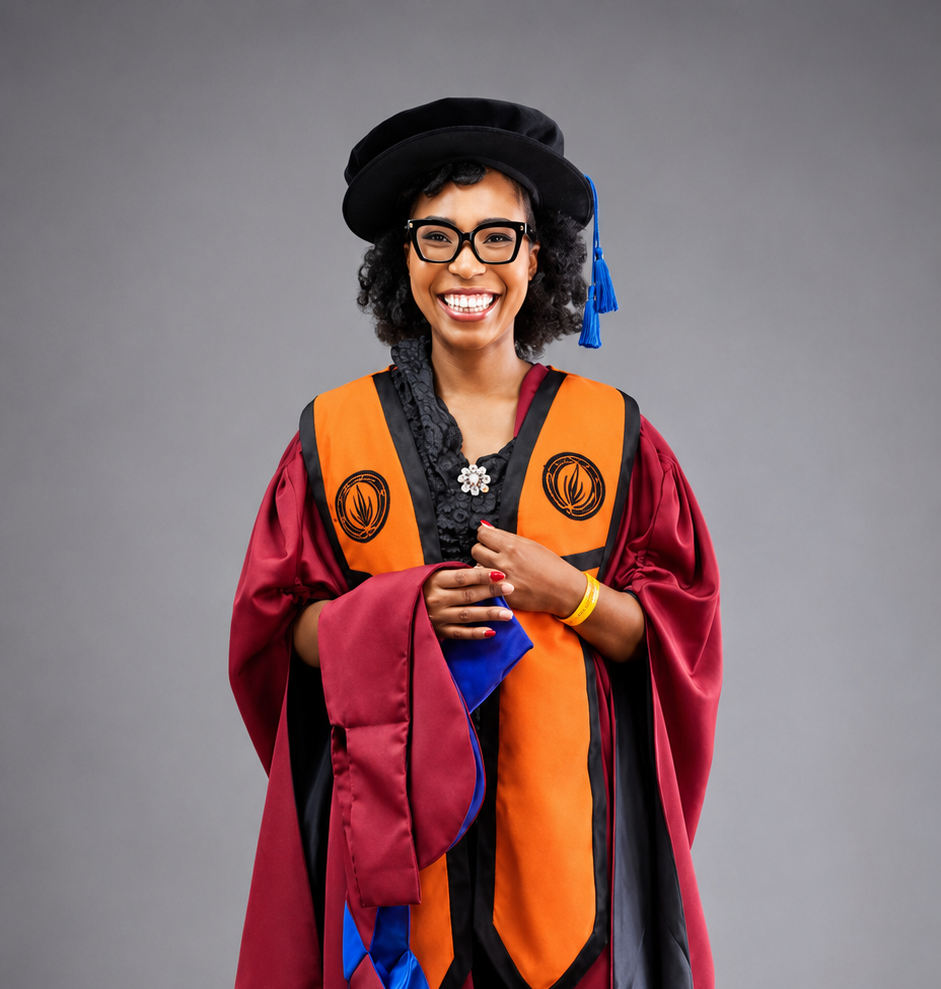 For Dr Sibukele Gumbo, the road to a PhD has been paved not only by academic rigour, but by countless journeys into some of the Eastern Cape’s most remote communities, where she has worked tirelessly to bring digital skills to people who need them most.
It is this grassroots work, rooted in a commitment to empowering marginalised communities, that has given particular meaning to her recent doctoral achievement.
The Eastern Cape e-Skills CoLab Director recently obtained a PhD in Applied Data Science from the University of Johannesburg (UJ), becoming the first person at Walter Sisulu to hold the qualification.
Her doctoral study, titled “Building Sustainable Models to Deliver Fourth Industrial Revolution (4IR) Skills”, examined how 4IR skills can be developed and delivered sustainably in resource-constrained environments, using the Eastern Cape as its primary context.
For Gumbo, the research is inseparable from the work she has undertaken across the province.
“I think this achievement is particularly significant as this qualification produced its first graduate only two years ago in 2024, with myself becoming the fourth graduate of the UJ PhD programme. This is the first of its kind within Walter Sisulu,” she said.
Her research comprised four interconnected studies examining the global 4IR skills landscape and was guided by a pragmatic mixed-methods approach incorporating bibliometric analysis, a systematic literature review, policy-level action research and stakeholder interviews.
Importantly, the research produced a practical outcome - an Eastern Cape 4IR stakeholder coordination model that positions NEMISA, which funds her work, as a coordinating entity within an ecosystem bringing together government, higher education, industry, research organisations and communities.
“The findings emphasised that sustainable digital skills development requires collaboration, clearly defined roles, community participation and shared accountability,” Gumbo explained.
Her research also explored facilitated online learning, finding that facilitator leadership, ease of use, satisfaction and social support are important in sustaining engagement with blended online learning in communities where habit and hedonic motivation may be limited.
Gumbo’s digital skills development work has reached all local municipalities in the Eastern Cape, supporting programmes in digital literacy, 4IR skills and cellphone repair.
Her work has also expanded into the university environment, where she recently facilitated certified Microsoft Digital Literacy courses for first-year entering students, enabling them to develop foundational digital competencies alongside their academic studies.
She has further introduced students to Data Science and Artificial Intelligence through masterclasses focused on Python programming and self-paced learning.
For Gumbo, the PhD therefore represents far more than an academic milestone. It is the culmination of a journey in which community work has informed research, and research has, in turn, strengthened practical interventions.
“I think my work demonstrates how research can inform practical interventions that extend beyond the university and contribute to building a digitally skilled society across the province,” she said.
By Thando Cezula
Walter Sisulu University
Every gift moves us forward.
The Walter Sisulu Legacy Fund is an opportunity for alumni, staff, partners and friends of the University to invest in the long-term future of Walter Sisulu.
It exists to expand opportunity for students, support academic excellence and innovation, respond to strategic priorities, and build a more resilient institution.
Why give? Because the strength of a university is built across generations. Your contribution helps Walter Sisulu to:
Join the movement. Watch the Fund grow. Add your name to the legacy.