About Walter Sisulu
Get in touch
Email Address:
Contact Numbers:
Mthatha: 047 502 2100
Butterworth: 047 401 6000
East London: 043 702 9200
Potsdam: 043 708 5200
Chiselhurst: 043 709 4000
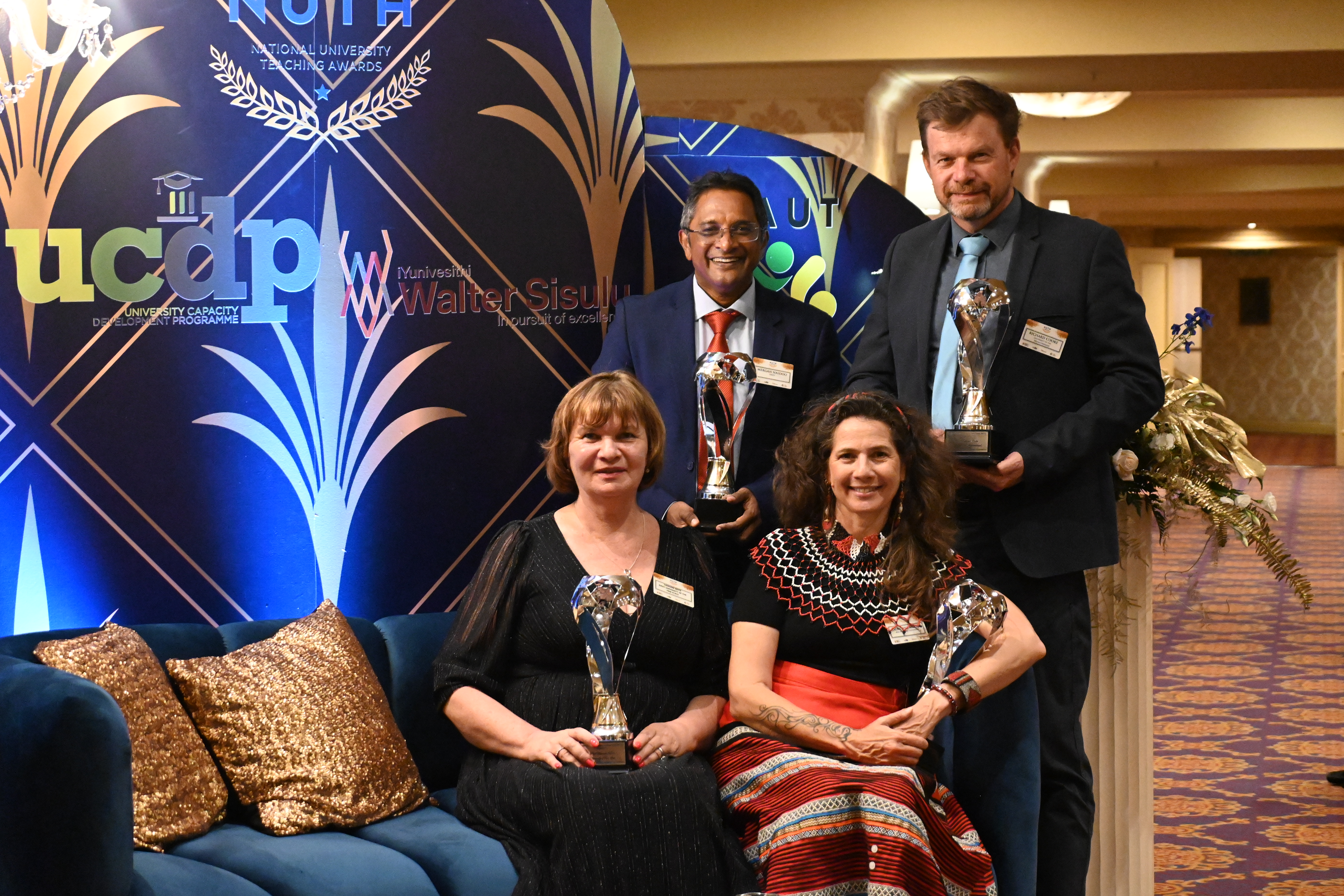
A national effort to improve how doctors are trained and mentored received recognition at the 2026 National University Teaching Awards (NUTA), with iYunivesithi Walter Sisulu (Walter Sisulu) academic Dr Madeleine Muller among the team members honoured in Johannesburg on Friday, 20 November.
The team received a Collaboration Award for developing the Supervisor Workplace Assessment Training (SWAT), a programme designed to equip medical specialists with the skills to teach, mentor and assess doctors undergoing specialist training in clinical workplaces.
Initiated in January 2025 by the Colleges of Medicine of South Africa (CMSA) and the South African Committee of Medical Deans (SACOMD), the programme brought together health profession educators from different universities to strengthen specialist training across the country.
Explaining the need for the initiative, Dr Muller said the medical specialists were trained in busy clinical workplaces every day, yet receive little formal preparation for their educational role.
The SWAT collaborative comprised Dr Muller of Walter Sisulu, Prof Hanneke Brits of the University of the Free State, Prof Bob Mash of Stellenbosch University, Prof Richard Cooke of the University of the Witwatersrand, Prof Mergan Naidoo and Prof Veena Singaram of the University of KwaZulu-Natal, and Prof Tashneem Harris of the University of Cape Town.
Dr Muller, contributed to conceptualising the programme and developed a module titled Know Yourself, Your Environment and Your Registrar.
“As we represent different institutions and different disciplines, we were able to conceptualise a training that could be adapted to a wide variety of different settings,” she said.
The programme had already reached 645 clinical supervisors across all 10 medical schools and 32 disciplines by 20 November 2026.
Beyond workplace assessments, the programme also sought to improve the learning environment for doctors undergoing specialist training by encouraging meaningful feedback, reflection and more supportive relationships between supervisors and trainees.
“While workplace-based assessment provides the practical focus, our broader goal is cultural transformation: helping supervisors move beyond traditional hierarchical approaches and towards educational practices grounded in trust, feedback, reflection and learner centredness,” Dr Muller said.
At Walter Sisulu, 69 clinical supervisors across all three deaneries had completed the programme, representing disciplines ranging from Family Medicine and Paediatrics to Emergency Medicine, Pathology and Surgery.
Making the training accessible to busy clinicians was one of the challenges the team faced. The original two-day programme made it difficult for smaller departments to release doctors to attend.
“Our biggest challenges have been getting busy clinicians to attend trainings. The original training was two full days, but small departments found it difficult to release doctors to attend,” Dr Muller said.
She helped adapt the face-to-face training into four online webinars of three hours each. A shorter Basic SWAT programme, consisting of three two-hour modules, was also piloted and received positive feedback.
The collaboration also contributed to the 2026 handbook Trust and Entrustability in Medical Specialist Training in South Africa: An Ubuntu-inspired Pedagogy. Dr Muller was lead author of one chapter and co-author of three others.
Reflecting on the award, she said the recognition helped build credibility for the programme and strengthen its rollout across Walter Sisulu departments.
“My dream is to transform clinical learning environments, and this award is a milestone on that journey,” she said.
The team was working to expand the programme through a national network of SWAT instructors, with further training planned across universities and medical disciplines in 2027 which Dr Muller was also set to lead a research project evaluating its impact.
By: Yolanda Palezweni
Walter Sisulu University
Every gift moves us forward.
The Walter Sisulu Legacy Fund is an opportunity for alumni, staff, partners and friends of the University to invest in the long-term future of Walter Sisulu.
It exists to expand opportunity for students, support academic excellence and innovation, respond to strategic priorities, and build a more resilient institution.
Why give? Because the strength of a university is built across generations. Your contribution helps Walter Sisulu to:
Join the movement. Watch the Fund grow. Add your name to the legacy.