

About Walter Sisulu
Get in touch
Email Address:
Contact Numbers:
Mthatha: 047 502 2100
Butterworth: 047 401 6000
East London: 043 702 9200
Potsdam: 043 708 5200
Chiselhurst: 043 709 4000
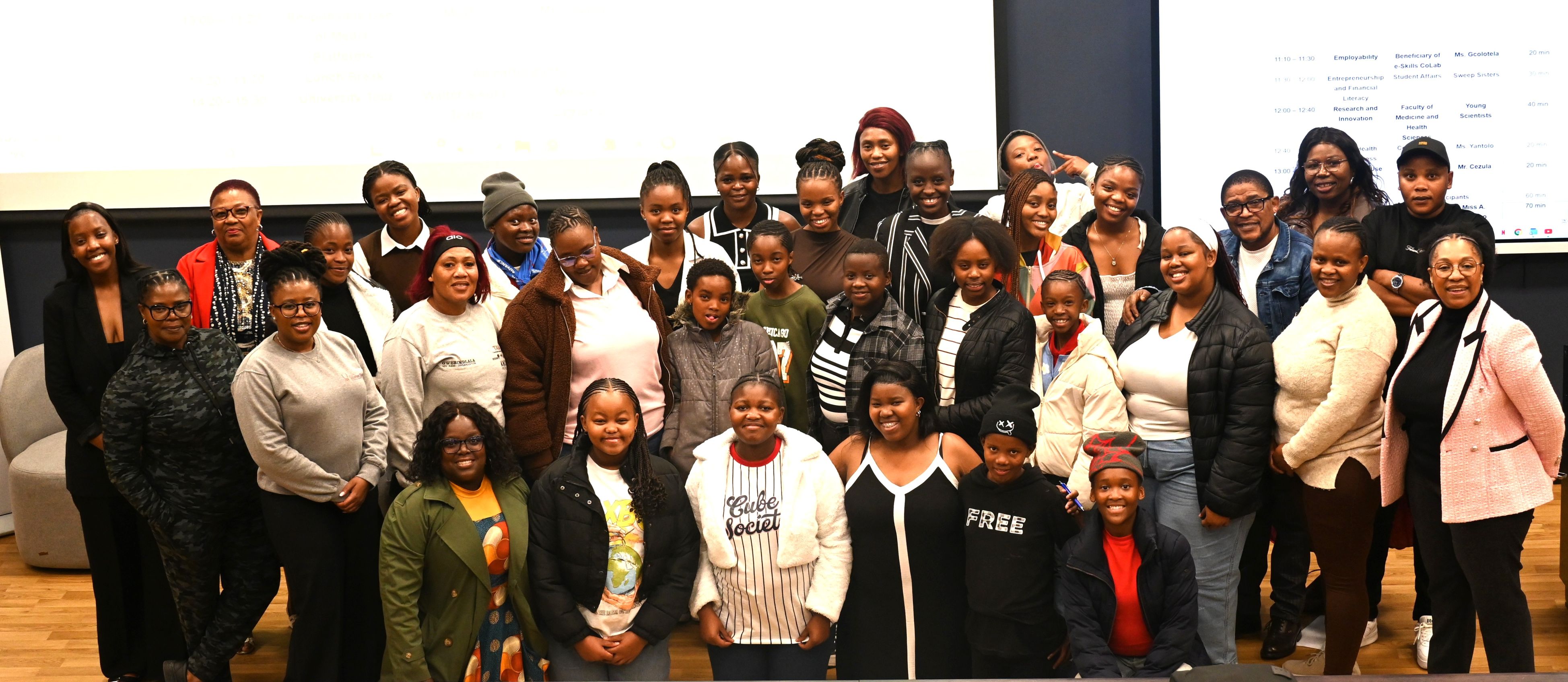
A group of promising young girls from Mdantsane, just outside KuGompo, recently stepped onto Walter Sisulu’s Potsdam Site with more than mere curiosity, arriving with ambition and determination, and leaving inspired to see themselves as future leaders, innovators, and university graduates.
The visit, facilitated by the non-profit organisation, South African Women in Dialogue (SAWID) through its Her Rising Leadership Program, brought together 15 girls aged between 12 and 16 for a day of engagement on issues shaping the lives and futures of young women and girls.
Hosted by the university's Transformation and Language Directorate, the programme explored topics ranging from science, technology, engineering and mathematics (STEM), entrepreneurship and financial literacy to mental health, gender-based violence, employability and the responsible use of social media.
Director of the Transformation and Language Directorate, Dr Kedibone Chembe, said the university immediately embraced the partnership because it aligns with Walter Sisulu's Vision 2040+ Strategic Framework and its commitment to community development.
"We did not hesitate to embrace this opportunity because it aligns directly with Walter Sisulu's Vision 2040+ Strategic Framework and our developmental mandate to co-create flourishing and sustainable futures for the people of the Eastern Cape, South Africa, the African continent and beyond," said Chembe.
She explained that introducing young girls to the university environment at an early age helps them recognise higher education as both accessible, attainable, and achievable.
"By partnering with organisations such as SAWID, we can engage with young girls long before they make decisions about higher education, helping them see themselves as future university students," she said.
Deputy Executive Dean of the Faculty of Natural Sciences, Prof Palesa Sekhejane, challenged the participants to consider careers in STEM while highlighting the persistent underrepresentation of women in scientific fields.
Citing international research, she noted that women accounted for just 31.1% of researchers worldwide, despite gradual progress in gender representation.
"The greatest loss is not simply unequal representation, but the talent and innovative solutions the world misses when women are excluded from STEM," Sekhejane said.
She stressed that diversity remains one of the strongest drivers of innovation.
"Studies consistently show that diverse teams are more innovative, productive and successful because different experiences and perspectives unlock new ways of solving problems," she added.
In conclusion, Chembe urged the girls to become responsible digital citizens, reminding them that social media can either create opportunities or cause lasting harm.
"Social media is one of the most powerful tools available to young people today. It can educate, connect, and inspire, but if used irresponsibly, it can damage reputations, affect mental well-being, and close doors that may have taken years to open. In today's digital world, a single post can have lifelong consequences," she said.
By Thando Cezula
Walter Sisulu University
Every gift moves us forward.

The Walter Sisulu Legacy Fund is an opportunity for alumni, staff, partners and friends of the University to invest in the long-term future of Walter Sisulu.
It exists to expand opportunity for students, support academic excellence and innovation, respond to strategic priorities, and build a more resilient institution.
Why give? Because the strength of a university is built across generations. Your contribution helps Walter Sisulu to:
Join the movement. Watch the Fund grow. Add your name to the legacy.